Navigating Divorce as an NRI: Legal Challenges, Solutions, and How It Can Be Done

Divorce is never a simple matter. Even in the most straightforward circumstances, it involves legal procedures, emotional difficulty, and decisions that carry lasting consequences. For a Non-Resident Indian, it involves all of that, and considerably more.
An NRI dealing with a divorce must grapple with questions that most people never have to consider.
✔ Which country’s courts have the authority to grant the divorce?
✔ Will a divorce obtained abroad be legally valid in India?
✔ What happens to property held in India?
✔ How does one participate in legal proceedings while living thousands of kilometres away from the court?
✔ What about the children, particularly when each parent wants to live in a different country?
These are not questions with quick answers. They require an understanding Of Indian family law, the laws of the country where the NRI is living, and, critically, how two legal systems interact.
For Muslims: Marriages are governed by Muslim personal law. When going to court for divorce, the main law is the Dissolution of Muslim Marriages Act, 1939. A husband can give talaq but it must follow proper Islamic procedure (talaq-e-ahsan or hasan). Instant triple talaq is banned and is a criminal offence. A wife can seek judicial divorce (khula or on grounds like cruelty, desertion, failure to maintain, etc.). Mehr (dower) is an important right that can be claimed. Maintenance can be claimed under personal law as well as under Section 144 of Bharatiya Nagarik Suraksha Sanhita. If talaq or divorce is done abroad, it still needs to meet the Section 13 CPC recognition rules in India (proper jurisdiction + natural justice).
By the end of this guide you will know:
✓ Why NRI divorce is more complicated than a regular divorce
✓ Which law and which court applies to your situation
✓ Whether a foreign divorce will be valid in India
✓ What happens with children, money, and property
✓ How to manage the whole process without living in India
✓ Step-by-Step: How the Process Works
✓ How a legal management service can handle everything for you.
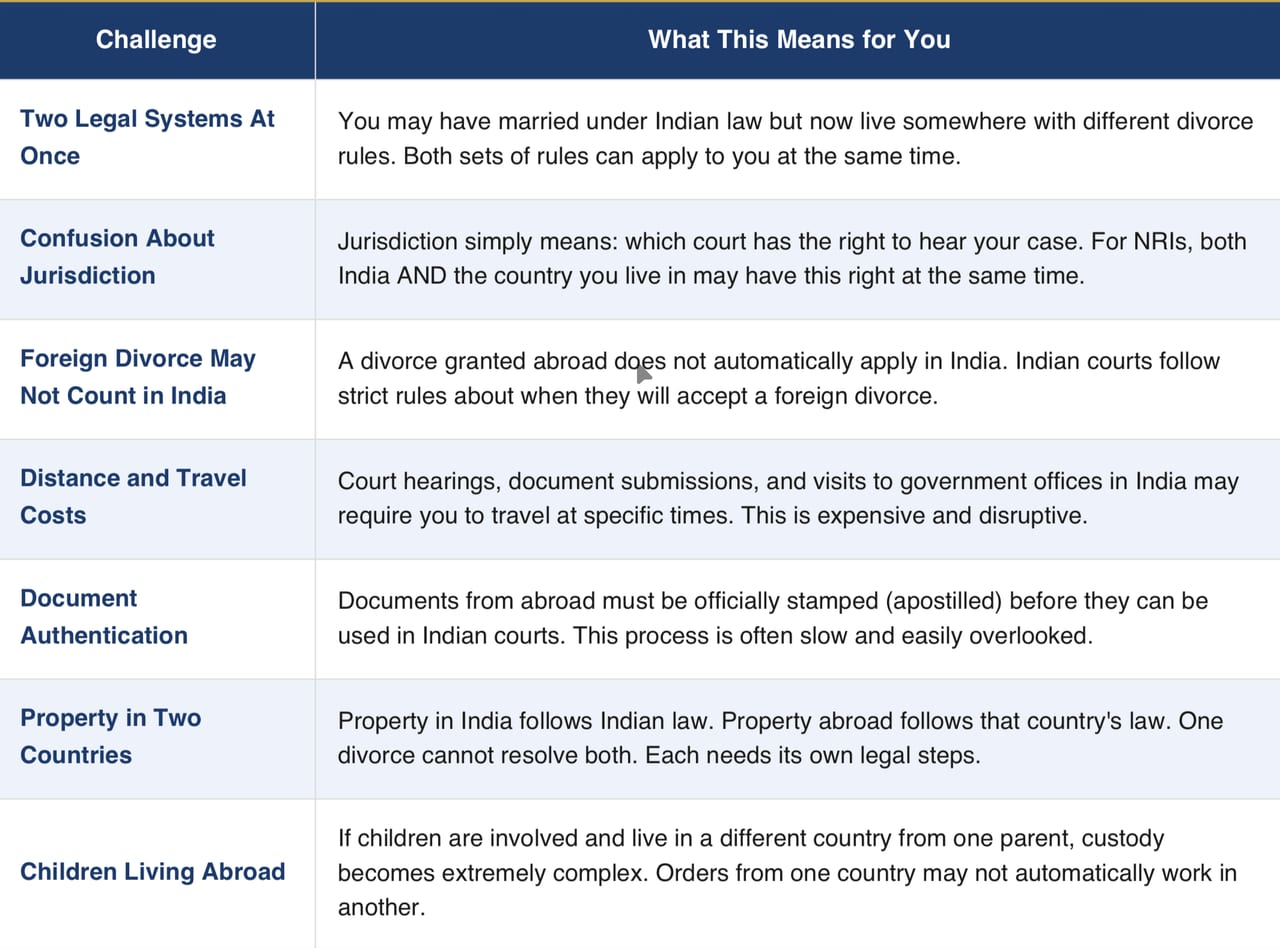
Why NRI Divorce Feels More Complicated
In a normal divorce, both people live in the same country, got married there, and go to the same court. Rules are clear.
For an NRI, almost nothing is simple. Here is why:
Two legal systems at the same time: Indian law + law of the country where you now live. Both may claim authority.
Indian personal laws are religion-based: Hindu Marriage Act, Special Marriage Act, Indian Divorce Act, Dissolution of Muslim Marriages Act. These still apply even if you live abroad.
Distance is a real problem: Court dates, documents, and meetings are in India. You are thousands of km away. Time zones make talking difficult.
Orders don’t travel automatically: A divorce or maintenance order from USA, UK, Canada, Australia etc. is not automatically valid or enforceable in India (and vice versa).
Money & property in two countries: Different currencies, different laws, extra paperwork and FEMA rules for Indian assets.
Children may be in one country, case in another: Custody fights become very emotional and legally messy.
■ Good News: With proper planning, good advocates, and coordination support, most NRI divorces can be handled without constant travel to India.
The Questions Every NRI Asks First
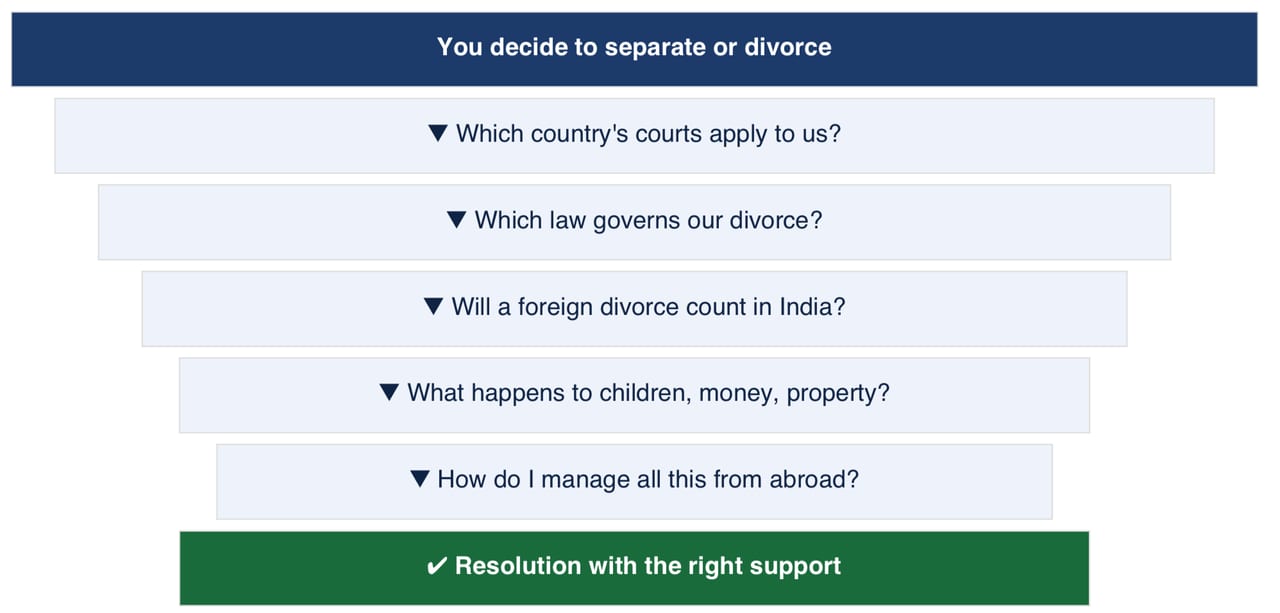
Most NRIs start with these practical questions. Here are straight answers:
Q1: Was our marriage registered under Indian law or foreign law?
This matters a lot. If you married in India under Hindu Marriage Act, Special Marriage Act, Muslim Law or other Indian law, Indian courts keep a permanent connection to your marriage no matter where you live now. If you married abroad under that country’s law, it depends on your nationality, religion, and current domicile.
Q2: Should I file for divorce in India or in the country where I live now?
There is no single right answer. Both options may be possible. The right choice depends on your facts.
Tip: If significant property is in India or one spouse lives in India, filing in India is often safer for recognition and enforcement.
Q3: Will a divorce I get abroad be valid in India?
This is the biggest trap. Short answer: It depends. Many NRIs think a foreign divorce is automatically valid in India, it is not! Indian courts apply Section 13 of the Code of Civil Procedure. If the foreign divorce fails any of the tests, it will not be recognised. You could face serious problems (including bigamy if you remarry). See detailed section below.
Q4: What happens to our property in India?
Indian property is governed by Indian law, no matter where the divorce happens. Even if you get divorced abroad, you usually need separate steps in India to divide or transfer Indian property unless you have a very clear, comprehensive settlement agreement that is properly documented and registered.
Q5: Can I manage the entire divorce from abroad without coming to India?
In many cases, yes, especially mutual consent divorce. Indian courts have expanded video conferencing for hearings. You can use a Special Power of Attorney (PoA) for many administrative and procedural steps. However, in contested cases, the court may still require your personal appearance for important stages (like giving evidence). Never assume, get specific advice early.
Q6: What about our children?
Child custody in cross-border cases is one of the most sensitive areas. Indian courts decide based on the best interest and welfare of the child. They take jurisdiction seriously even if the child is currently abroad. This can lead to parallel proceedings in two countries. Act early and get specialist advice.
Where to File: Choosing Jurisdiction
The word jurisdiction just means: which court is allowed to handle your divorce. For NRIs, more than one court may have this right at the same time. Choosing where to file is one of the most important early decisions.
Will a Foreign Divorce Be Valid in India?
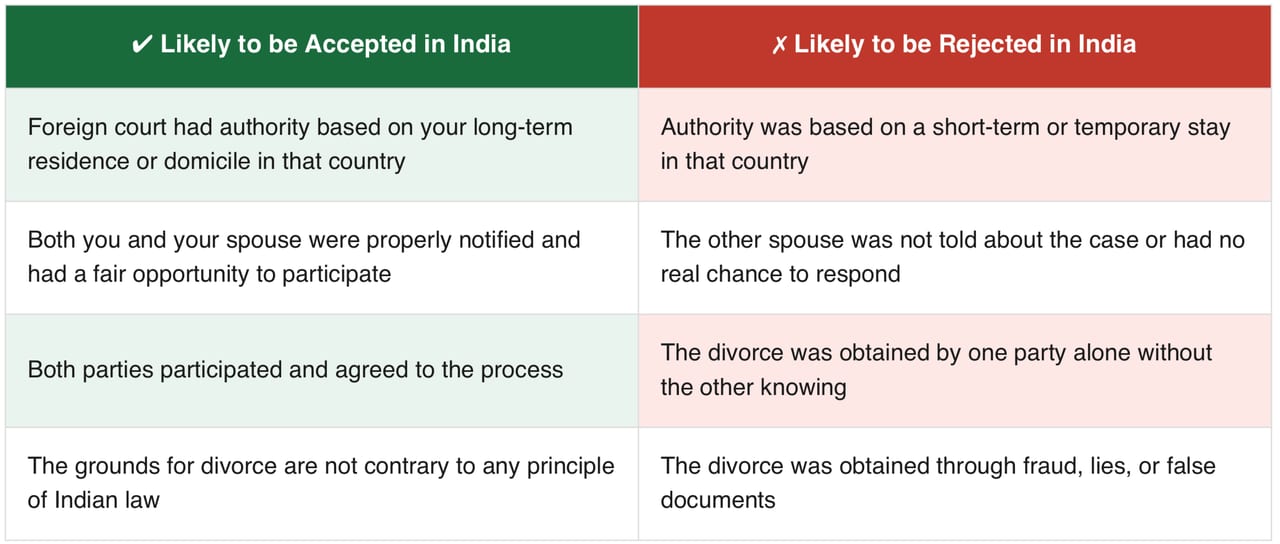
Many NRIs make a very costly mistake: they assume that a divorce they got in another country is automatically valid everywhere, including in India. It is not. Indian courts follow very specific rules to decide whether they will accept a foreign divorce. If your divorce does not meet these rules, India will treat you as still married, even if you are legally divorced in another country.
■ Real risk: Several NRIs have believed they were divorced, got remarried, and then discovered that India never recognised the first divorce. This can lead to very serious legal trouble, including charges of bigamy (being married to two people at once).
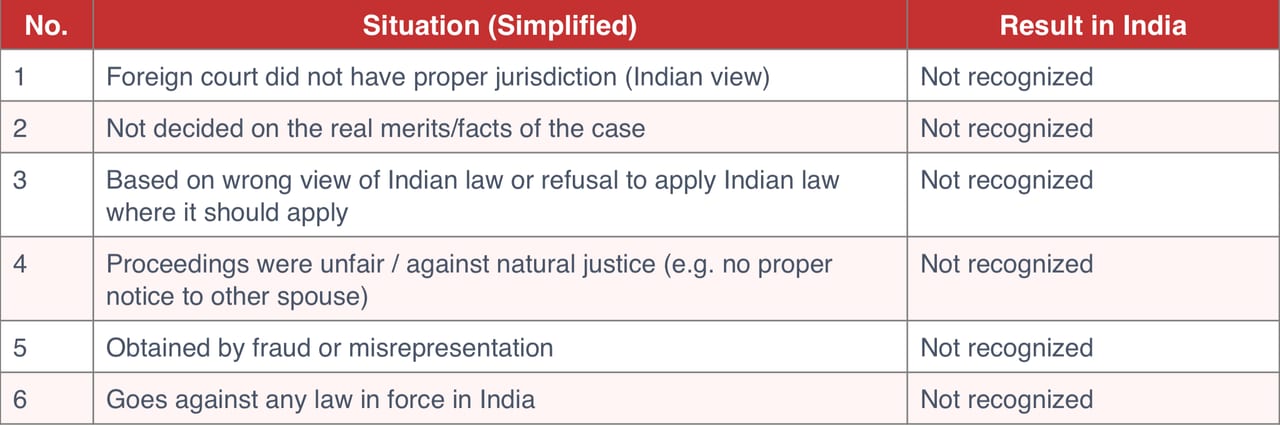
A foreign divorce will NOT be accepted by Indian courts if any one of these six conditions applies. Think of them as six doors. If even one door is open, India will reject the foreign divorce.
(a) No Proper Authority: The foreign court did not have the proper legal right to hear the case by standards that India would recognise.
(b) Not on the Merits: The divorce was not decided based on the actual facts of the case. For example, it was granted by default because no one showed up.
(c) Wrong Legal Basis: The foreign court applied an incorrect understanding of international law, or refused to apply Indian law when it should have.
(d) Natural Justice Violated: The other spouse was not properly notified about the case, or was not given a genuine opportunity to respond and participate.
(e) Obtained by Fraud: The divorce was obtained through lies, false documents, or any kind of dishonesty.
(f)Breaks Indian Law: The divorce supports a claim that would itself be illegal under Indian law.
What Should You Do?
If you already have a foreign divorce decree, get it confirmed by an Indian court before remarrying, transferring property, or taking any major step in India.
If you are planning to file abroad, make sure jurisdiction is solid under Indian standards and the other spouse gets proper notice and opportunity.
In mutual consent cases, a well-drafted comprehensive settlement helps, but recognition still depends on jurisdiction and natural justice.
Safe vs. Unsafe: When Will Your Foreign Divorce Be Accepted?
Children and Custody Across Countries
When a divorce involves children and one or both parents live abroad, custody becomes one of the hardest parts of the whole process. Indian courts always put the best interest of the child first. But when children and parents are spread across different countries, it becomes legally and practically very complex.
Key Points:
Indian courts take jurisdiction over children of Indian origin very seriously, even if the child is currently living abroad.
India has NOT ratified the Hague Convention on International Child Abduction. This creates asymmetry: A parent who takes a child from a Hague country to India cannot be forced to return under the Convention, but the other parent may face proceedings in the foreign country.
However, Indian courts have in many cases ordered return of children to their country of habitual residence when it is in the child’s best interest (as a matter of comity and welfare, not treaty obligation).
There is no automatic recognition of custody orders between India and most other countries. A parent with an Indian order must still get it enforced abroad through local courts.
Courts consider: child’s age, school, language, relationships/attachments, health, which environment is their established home, and wishes of mature children.
■ Act Early on Custody: In international custody matters, early action is critical. Delay can work against you because courts may see the current location as the child's settled environment. Seek specialist legal advice immediately if there is any risk of removal or retention of the child.
Practical Steps if Custody is an Issue
1. Consult a lawyer experienced in international family law right away.
2. Do not take unilateral action (removing or keeping the child) without legal advice, it can backfire badly.
3. Document everything: school records, daily care, relationships.
4. Be prepared for possible parallel proceedings in two countries.
5. Focus on the child’s welfare in all communications and court filings.
Maintenance / Alimony & Financial Issues
Money matters in NRI divorce cover three areas: maintenance (regular payments to a spouse or children), the division of assets, and property in more than one country. Each has its own rules and its own challenges.
Maintenance:
During the case (pendente lite): Either spouse can ask for maintenance.
After divorce (permanent alimony): Court can order. Amount depends on income, needs, lifestyle, children's needs, etc.
Quick remedy for wife & children: Section 144 of Bharatiya Nagarik Suraksha Sanhita (new name for old Section 125 CrPC) is available regardless of religion. Designed for faster relief.
Foreign income counts: Indian courts regularly consider salary slips, tax returns, bank statements from abroad. Currency difference does not hide the income.
Enforcement of Maintenance Orders
An Indian maintenance order is easy to enforce if the paying person has assets or income in India. If they live abroad with no Indian assets, you must get the order recognised and enforced in that foreign country (depends on that country’s laws and any bilateral arrangements with India). The reverse is also true for foreign orders in India.
Division of Assets: Important Difference
Unlike some Western countries, Indian personal law does not automatically require equal (50-50) division of marital property. Courts have wide discretion. In mutual consent divorces, parties negotiate and agree on terms, which are recorded in the petition and decree. In contested cases, full financial disclosure is expected. Courts can consider dissipation of assets or transfers made to defeat claims.
Property held only in one spouse’s name is not automatically divided, but overall financial position, contributions during marriage, future needs, and children’s needs are all relevant.
Property Across Countries
If you own property in India AND in another country, each country's laws apply separately to its own property. One divorce cannot sort out everything in one go.
Practical Tip: If you are doing a mutual consent divorce, agree on all property in all countries as part of your settlement and put it in writing. Include it clearly in the divorce petition. This avoids separate arguments later.
Managing the Process From Abroad
One of the biggest fears NRIs have is that they will need to fly to India constantly throughout the divorce process. In most cases, this fear is exaggerated. With the right planning, many steps can be handled remotely. The two main tools for this are the Power of Attorney and India’s digital court system.
The Power of Attorney: What It Is and Why It Matters
A Power of Attorney (POA) is a legal document that gives another person the authority to act on your behalf. A Special Power of Attorney (SPA) covers specific tasks only. Here is how to set one up from abroad:
Get It Drafted: Work with an advocate to prepare the SPA. The document must state exactly what the person is allowed to do on your behalf.
▼
Sign It Before a Notary: Sign the document in front of a Notary Public in the country where you live. The Notary officially confirms that you signed it.
▼
Get the Apostille Stamp: Take the notarised document to the relevant government authority in your country and get it apostilled. An apostille is an internationally recognised official stamp. India verifies apostilles through the e-Sanad portal (esanad.gov.in).
▼
Send It to India: Send the original apostilled document to your representative or advocate in India by a tracked, reliable courier.
▼
Register It in India: For property matters, the SPA must also be registered at the Sub-Registrar's office in the relevant area of India. This makes it legally effective for property transactions.
Read more about Power of Attorney in detail : All about Power of Attorney
Remote Court Participation
Thanks to the eCourts project, many Indian courts now allow parties to participate in hearings via video conferencing, especially in mutual consent divorce matters. You can check case status and participate through services.ecourts.gov.in in many cases. However, in contested proceedings, the court may still insist on personal presence for key stages (examination of parties, final arguments, etc.). The court has discretion. Get specific advice for your case type and court.
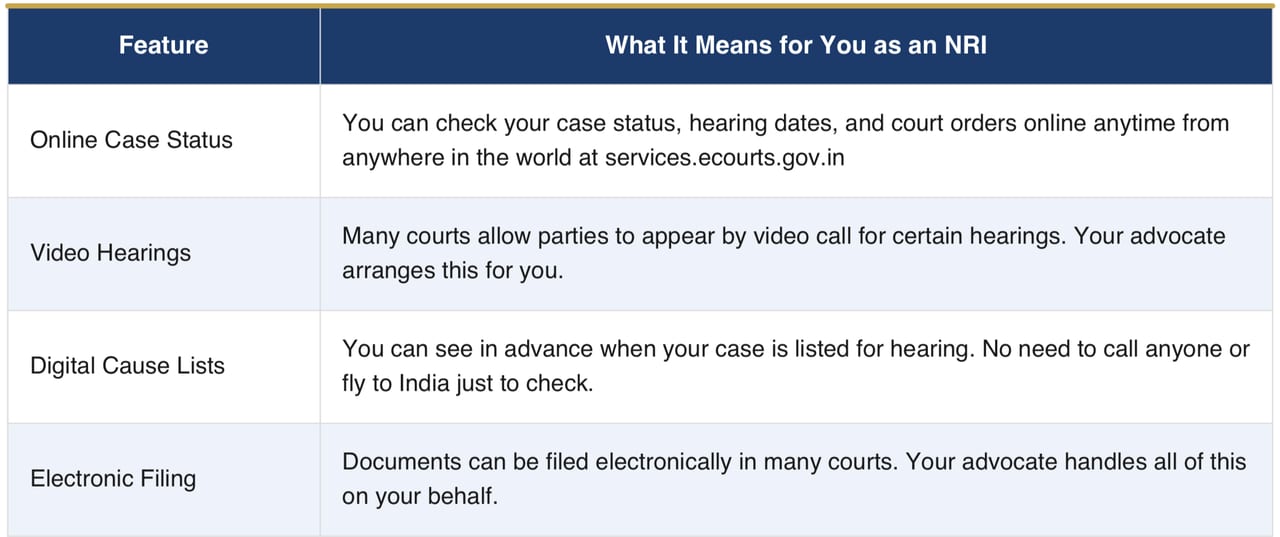
Step-by-Step: How the Entire Process Can Be Managed
Mutual Consent Divorce (Easiest & Most Manageable Route)
When both spouses agree to end the marriage and can agree on major issues (children, money, property), this is the cleanest path.
Both must have been living separately for at least 1 year.
Negotiate and prepare a clear written settlement covering all issues (kids, maintenance, property in all countries).
Choose the right Indian court jurisdiction (see earlier section).
Engage a competent advocate experienced in NRI matters.
Prepare all documents (marriage proof, ID proofs, address proofs, settlement, PoA if needed, apostilles where required).
File joint petition (First Motion) in court.
Attend First Motion hearing (video conferencing often allowed).
Wait period (statutory cooling-off – Supreme Court can waive in appropriate cases).
File Second Motion and attend hearing.
Court passes divorce decree.
Then implement the settlement (property transfers, etc.) with local steps in each country.
Contested Divorce
When one spouse does not agree or there are big disputes on money/children/property, the process is longer and more involved.
You will likely need to be present for some key hearings (evidence, cross-examination, final arguments).
However, with a good advocate and strong coordination, many routine hearings can proceed without your physical presence. The quality of day-to-day coordination (tracking dates, documents, instructions) determines whether the case moves efficiently or drifts for years.
The Smartest, Most Complete Solution
After reading this guide, you now understand why an NRI divorce is rarely just about filing a petition in court. It is a process involving multiple legal, administrative, and practical steps, many of which happen simultaneously.
Choosing the right advocate,
preparing documents,
executing a Power of Attorney,
dealing with court procedures,
managing communication,
attending to requirements in India,
monitoring hearings, and
responding to new developments
all require constant attention.
Most people assume that hiring an advocate solves all of these problems. In reality, an advocate is responsible for providing legal advice and representing your interests before the court. Everything else still needs to be managed, coordinated, and followed up. For someone living outside India, that responsibility can quickly become exhausting.
This is exactly why Global LMG was created.
Instead of expecting you to coordinate every stage of the process yourself, Global LMG manages the entire journey from beginning to end. You do not have to spend months figuring out what comes next, whom to contact, which documents are required, or how to manage everything from another country.
You simply tell us about your situation.
From there, we take ownership of the process and coordinate everything required to move your matter forward.
How Global LMG Help You
Here’s how we support you throughout your divorce journey.
Understanding Your Case and Planning the Best Strategy
Every case starts with a detailed discussion so we can fully understand your situation.
We learn about:
Your marriage and current circumstances.
Your goals, such as a quick settlement, child custody, financial security, or reducing conflict.
Your budget and any travel or time limitations.
Related issues such as children, property, maintenance, or domestic violence matters.
Based on this, we provide a clear and honest assessment.
We explain:
The strengths of your case.
Any challenges you may face.
Your legal options in simple language.
Whether mutual consent, negotiation, mediation, or contested proceedings are more suitable.
The likely costs, timelines, and risks involved.
Our recommendation on the best way forward.
This gives you a clear understanding of your situation before any legal action begins, helping you make informed decisions with confidence.
Finding the Right Advocate
Choosing the right advocate is one of the most important decisions in any legal matter.
Instead of giving you a list of lawyers, we carefully match you with the advocate best suited to your case.
We consider:
Experience in NRI divorce matters.
Knowledge of the relevant court and jurisdiction.
Experience in similar cases involving custody, maintenance, or property.
Communication style and availability.
If your matter involves several legal issues, we also determine whether one advocate can handle everything or whether a team of specialists would be more effective. If multiple advocates are needed, we coordinate their work so everyone follows the same strategy.
This saves you time, avoids confusion, and helps you start with the right legal team.
Your Dedicated Support Team
Throughout your case, Global LMG remains your single point of contact.
We:
Answer your questions.
Explain legal updates in simple language.
Help you stay organised.
Reduce the stress of managing the process from abroad.
Guide you through every stage of the case.
You never have to manage everything on your own.
Working with Your Advocate
We ensure smooth communication between you and your advocate.
Our role includes:
Following up regularly on your behalf.
Tracking important tasks and deadlines.
Making sure documents and instructions are shared on time.
Keeping you updated on the progress of your case.
Coordinating multiple advocates whenever required.
This keeps your case moving without unnecessary delays.
Document and Power of Attorney (PoA) Support
Managing documents from another country can be difficult. We make it simple.
We help you:
Prepare and organise all required documents.
Draft your Special Power of Attorney.
Complete notarisation and apostille.
Handle e-Sanad verification.
Arrange secure courier to India.
Coordinate registration where required.
Ensure documents are submitted correctly and on time.
Proper documentation helps avoid unnecessary delays and legal complications.
Managing All Connected Legal Matters
Many divorce cases involve more than just divorce.
We help coordinate related matters such as:
Child custody and visitation.
Maintenance and alimony.
Property and asset disputes.
Domestic violence proceedings.
Other connected civil matters.
By managing everything together, we help ensure a consistent legal strategy and avoid conflicting advice.
Complete Case Management
We manage the day-to-day coordination of your case so you don’t have to.
This includes:
Tracking hearing dates and deadlines.
Scheduling meetings and video calls.
Coordinating court filings and on-ground work in India.
Arranging remote participation whenever possible.
Providing regular progress updates.
Following up continuously to keep your case moving.
You always know what’s happening and what comes next.
Transparent and Practical Support
We believe legal support should be clear, efficient, and focused on results.
That’s why we:
Help avoid unnecessary legal expenses.
Encourage practical solutions such as mediation or settlement where appropriate.
Monitor progress and maintain accountability.
Keep you informed throughout the process.
Our goal is to help you achieve the best possible outcome with the least amount of stress.
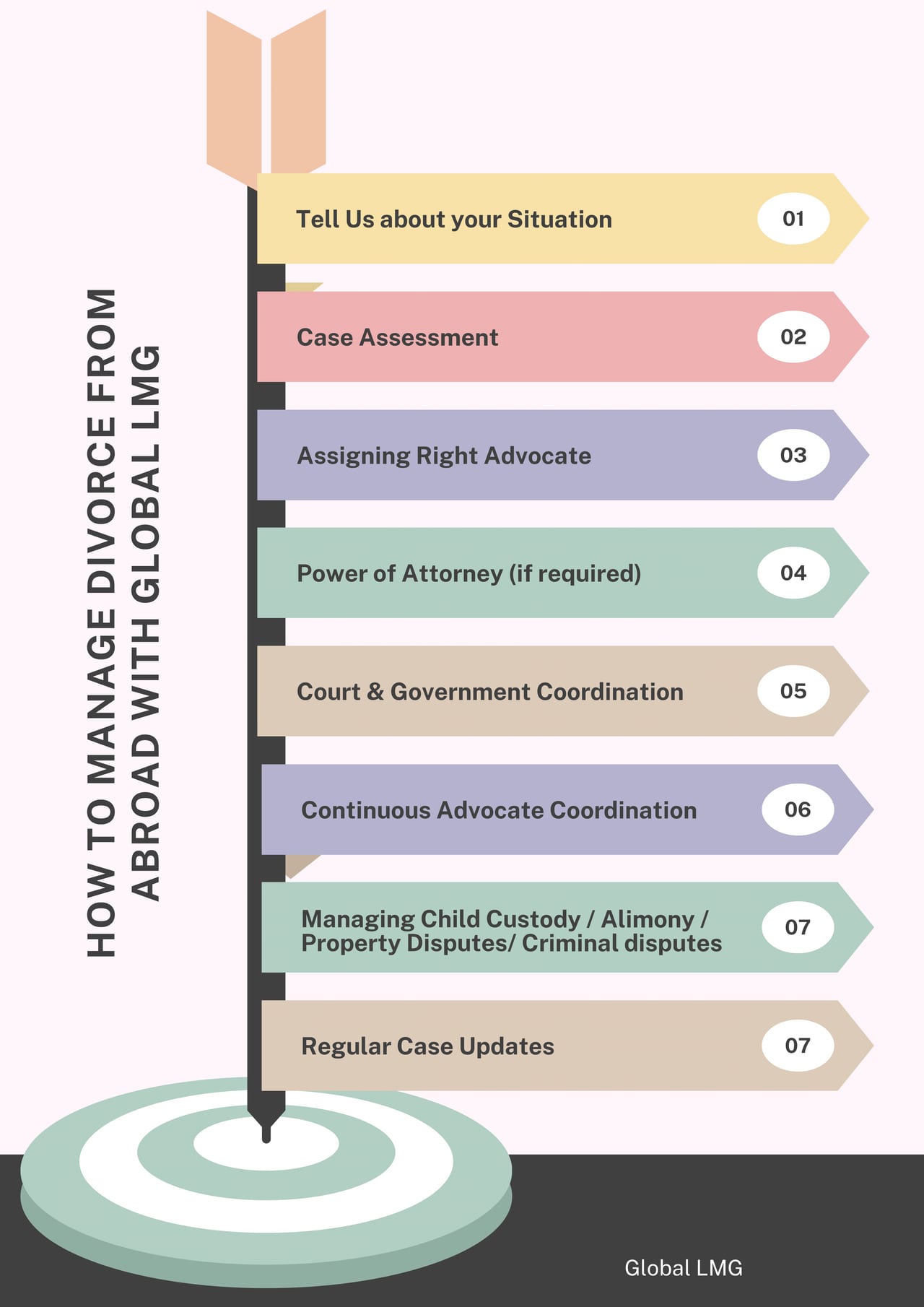
Final Thought: You Deserve Better Than “Just a Lawyer”
Finding a competent advocate is important.
Managing everything around that advocate, especially when you live abroad, is what actually determines how stressful, expensive, and successful your divorce journey will be.
Global LMG was built precisely for NRIs who want reliable, organised, transparent, and effective legal support without having to become experts or project managers themselves.
If you are an NRI facing divorce (or even just exploring your options), reach out to Global LMG today. One conversation can give you the clarity and confidence you have been missing.
Let us handle the complexity. You focus on your life and your future.
References
- Hindu Marriage Act, 1955 (Act 25 of 1955)
- Special Marriage Act, 1954 (Act 43 of 1954)
- Indian Divorce Act, 1869
- Dissolution of Muslim Marriages Act, 1939
- Guardians and Wards Act, 1890
- Hindu Minority and Guardianship Act, 1956
- Code of Civil Procedure, 1908 (Act 5 of 1908)
- Bharatiya Nagarik Suraksha Sanhita, 2023
- Bharatiya Nyaya Sanhita, 2023
- Foreign Marriage Act, 1969
- Foreign Exchange Management Act, 1999

